The First Encyclical for Holy Friday
of His Eminence Metropolitan Cleopas of Sweden and All Scandinavia
Episcopal Encyclical for Holy Friday
April 10, 2026
Dear fathers and brothers in Christ,
our beloved children,
Today we stand before the Epitaphios (Plashchanitsia), in the sacred sorrow of Holy Friday, to draw near to the mystery of the Divine Passions and to worship the Great Dead.
Holy Friday is the day when silence becomes a cry. The Church does not merely mourn a righteous man who died; she stands before the mystery of a God Who suffers and gives Himself “for the life and salvation of the world.”
In this silence, we hear the echo of pain—not only of Golgotha, but of every age.
The poetic exclamation “Elo Hi” (“My God”), inspired by the music of Goran Bregović, conveys this dramatic tension: “Is there a God, and does anyone love me?”
This image leads us to the suffering of modern man, for Christ is not crucified only then—He is mysteriously crucified in every age. In every person who suffers, “Christ is crucified anew.” The Divine Passions continue.
Today, the entire world resembles a boundless Golgotha. Wars rage incessantly. People are torn from their homes. Children lose their innocence and their lives. Where bombs fall, the cry “Crucify Him!” resounds once more.
Modern slavery—more insidious than ever—holds people in bondage not only with chains, but with poverty, exploitation, and despair. Man becomes an object, just as when Christ was betrayed “into the hands of men.”
And God’s creation—the environment—suffers wounds daily. The earth “groans and labors,” as the Apostle Paul says. The destruction of nature is also a form of crucifixion, a wound we ourselves inflict upon God’s creation, a sin, as Bartholomew I named it.
Amidst all this, man feels loneliness, echoing the cry of Christ on the Cross: “My God, My God, why have You forsaken Me?”
The experience of God’s “absence” is not a denial of God, but the depth of human pain, which God Himself takes upon Himself.
The poetic word continues: “Only for me is this truth still homeless.” Truth seems homeless, just as Christ was homeless in the world. God Himself experiences rejection, abandonment, and silence on the Cross.
This constant pain of human existence finds its answer in the Passions. Christ does not stand aloof from pain—He lives it in extreme humility.
Every human cry—spoken or unspoken—meets on the Cross.
Man acknowledges his weakness with the words: “One cannot forgive all life long,” but Christ answers with His life and sacrifice: you can! And not only can you—it is the only path to true life and salvation. The Lord forgives to the very end, and this is precisely what changes the world—love without limits!
Saint John Chrysostom says that the Cross is a victory, not a defeat, and Saint Gregory the Theologian reminds us that Christ accepts the entire human tragedy in order to transform it.
This means that every modern pain, every injustice, every tear can become a place of encounter with the Cross of Christ.
He also calls us not to be mere spectators of His Passions, but to become participants in His love. To become comfort where there is pain. To become light where there is darkness. To become peace in a world on fire. For if the world is crucified today, the answer has already been given: Christ is the love that sacrifices itself.
Before the Epitaphios, we do not only weep. We recognize Christ in every wounded person: in every refugee, in every wronged individual, in every victim of violence, in creation itself which groans.
In this modern loneliness and abandonment, life is born from Friday, because through the sacrifice of the Cross, the hope of the Resurrection dawns.
And though everything seems to lead to darkness, the Church already introduces the faithful into the light of the Resurrection. For the Cross is not the end. It is the transition to the Resurrection.
And if the heart asks: “Is there a God, and does anyone love me?”, the answer is clear: yes, God is—”everywhere present and filling all things”—and He loves, for His love is of the Cross and the Resurrection.
With sincere paternal wishes for a radiant Pascha,
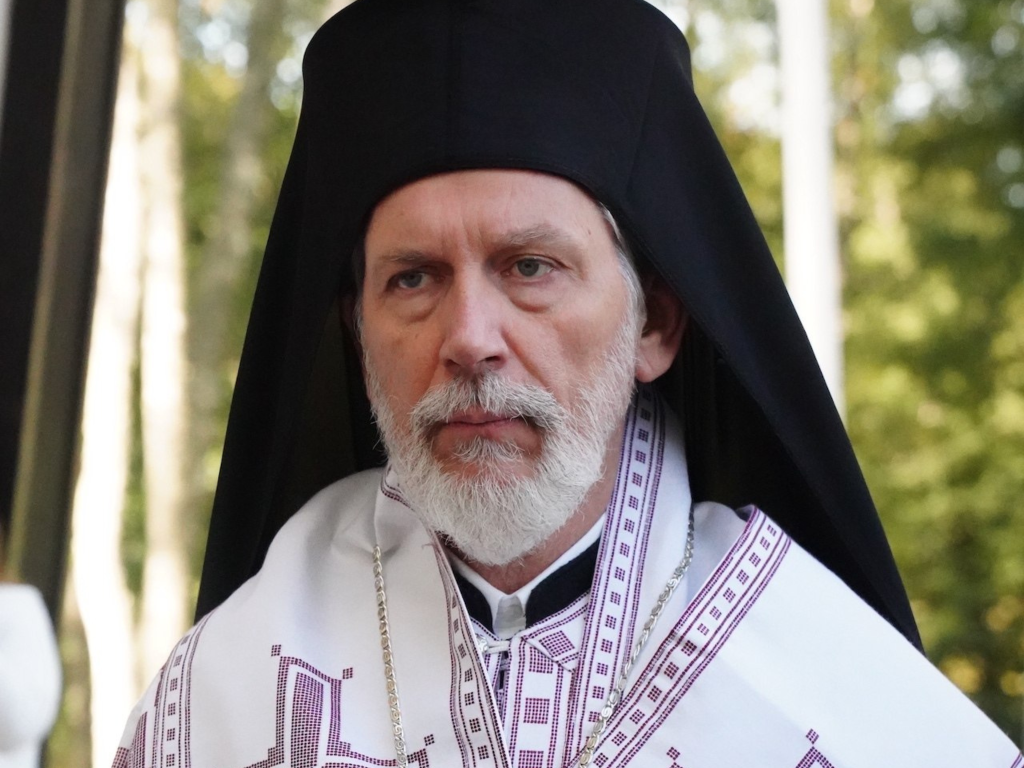
† Metropolitan Cleopas of Sweden and All Scandinavia